Husky Support ⋆🐾⋆
Role: UX Designer & Data Scientist
Medium: Python (VSCode), AWS, Claude
Hours spent: ~200
Duration: Jan - June 2026
Team members: 4
Project context: Capstone for Informatics Major
About: HuskySupport is a Slack-based predictive assistant that uses device telemetry data to detect anomalies and computer statistics. It predicts when a computer may be likely to have issues by surfacing plain-language root causes with guided resolution paths, so that employees can prevent crashes, protect unsaved work, stay up-to-date on their computer, and reach the right support channel without filing a ticket or repeating their issue to IT.
⚘ The Problem ⚘
Most system crashes don’t happen out of nowhere - they are usually preceded by measurable signals such as increasing CPU temperature, large memory utilization, longer boot times, and degraded battery. However, users only see symptoms, such as a slow or freezing laptop screen, or a black screen. Traditional IT support tends to be reactive in the sense that once a crash happens, the user opens a ticket, seeks help from an IT desk, and then ultimately gets a new computer if their issue is not easily mitigated. Throughout this process, they may have lost a lot of work and time. Below is our problem statement:
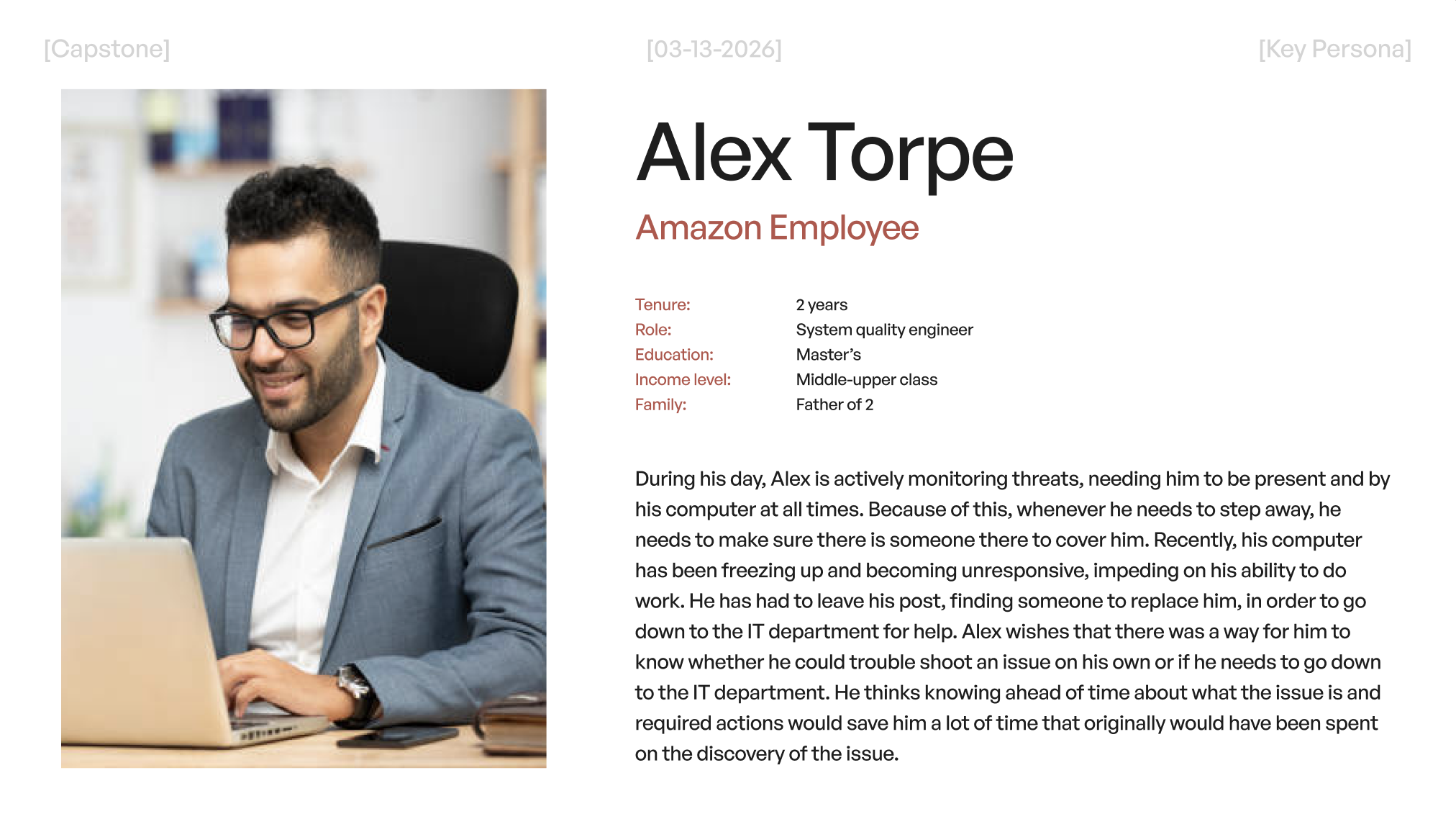
Problem Statement - How might Amazonians experiencing technical problems receive timely and accurate hardware problem diagnoses, while Amazon IT support engineers can more quickly identify device issues so that resolution time is reduced and work disruption is minimized?
🧩 Goals
Shift an aspect of Amazon IT support from reactive repair to predictive prevention to improve employee productivity and mitigate time/work lost.
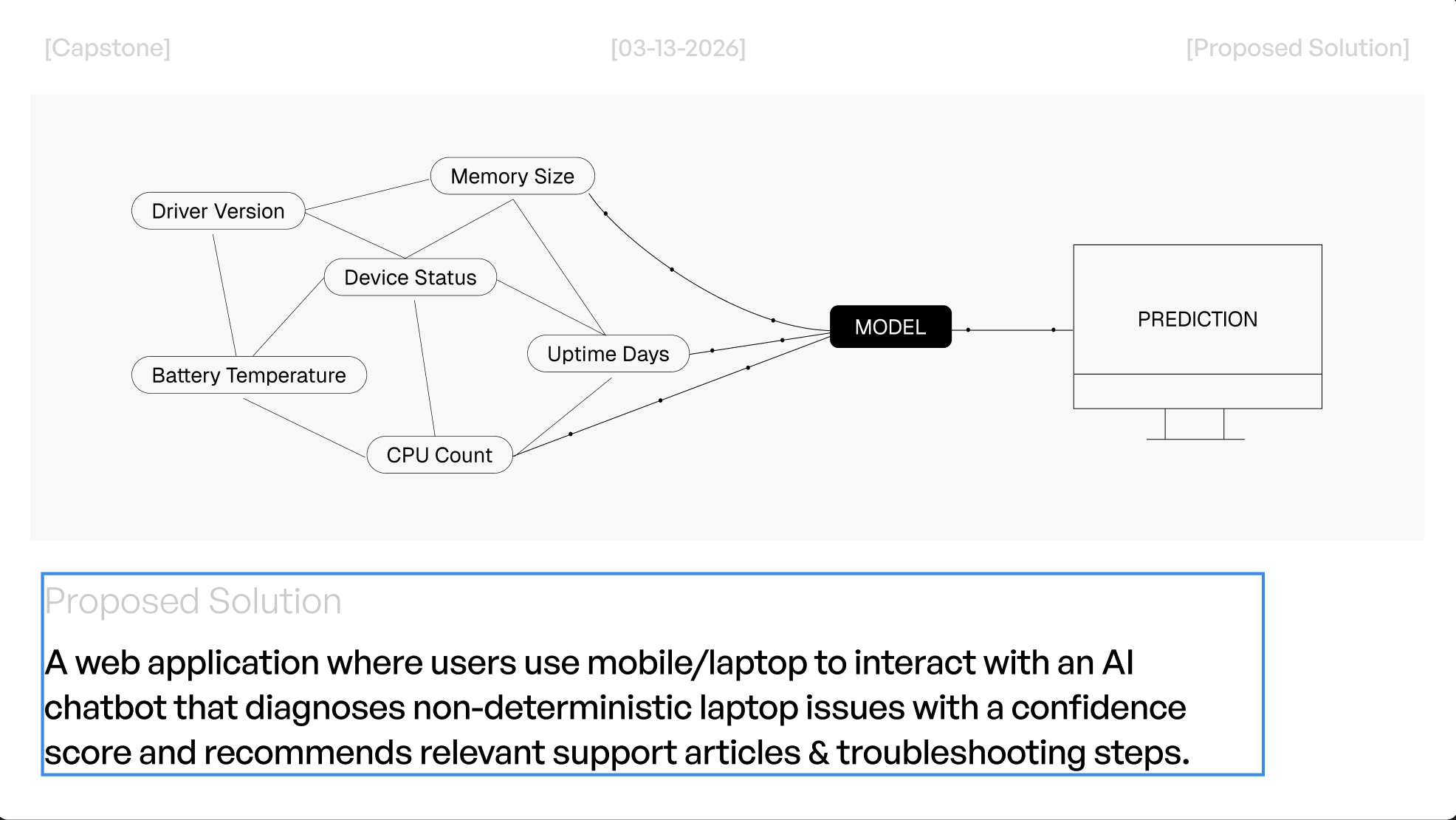
Achieve this by using a random forest model with device failure thresholds to translate raw device telemetry into root causes of device failure.
Surface this to employees with plain-language guidance that non-technical users can act on, and route them to the right resolution path (self-fix, backup & replace, online support, or in-person support) without wasting time on misdiagnosed tickets.
🔍 Process
📊 User Research
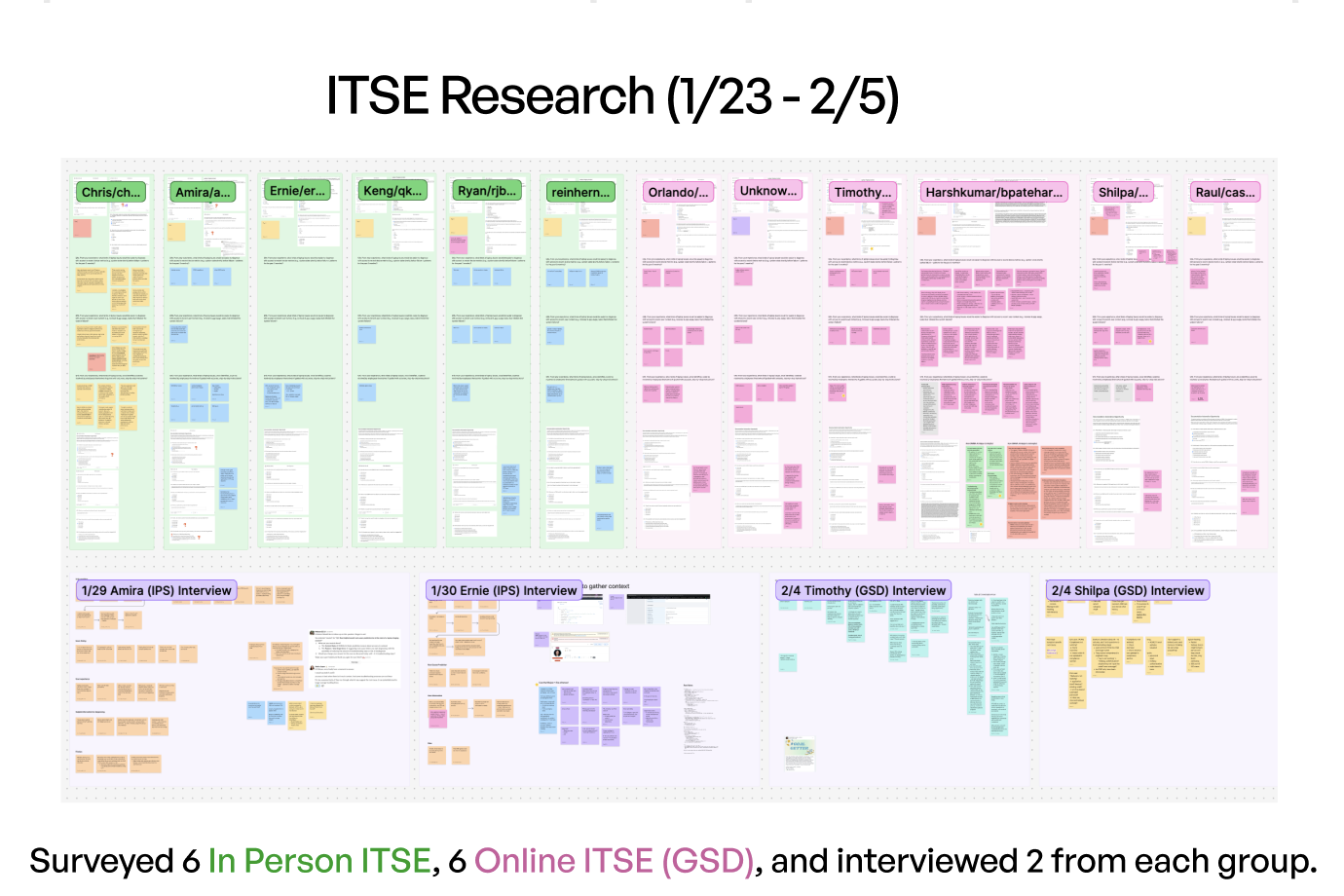
We conducted user research across IT Support Engineers and end users. This consisted of in-person conversations, Zoom interviews, and comprehensive Qualtrics forms.
📝 UX Design & Data Science
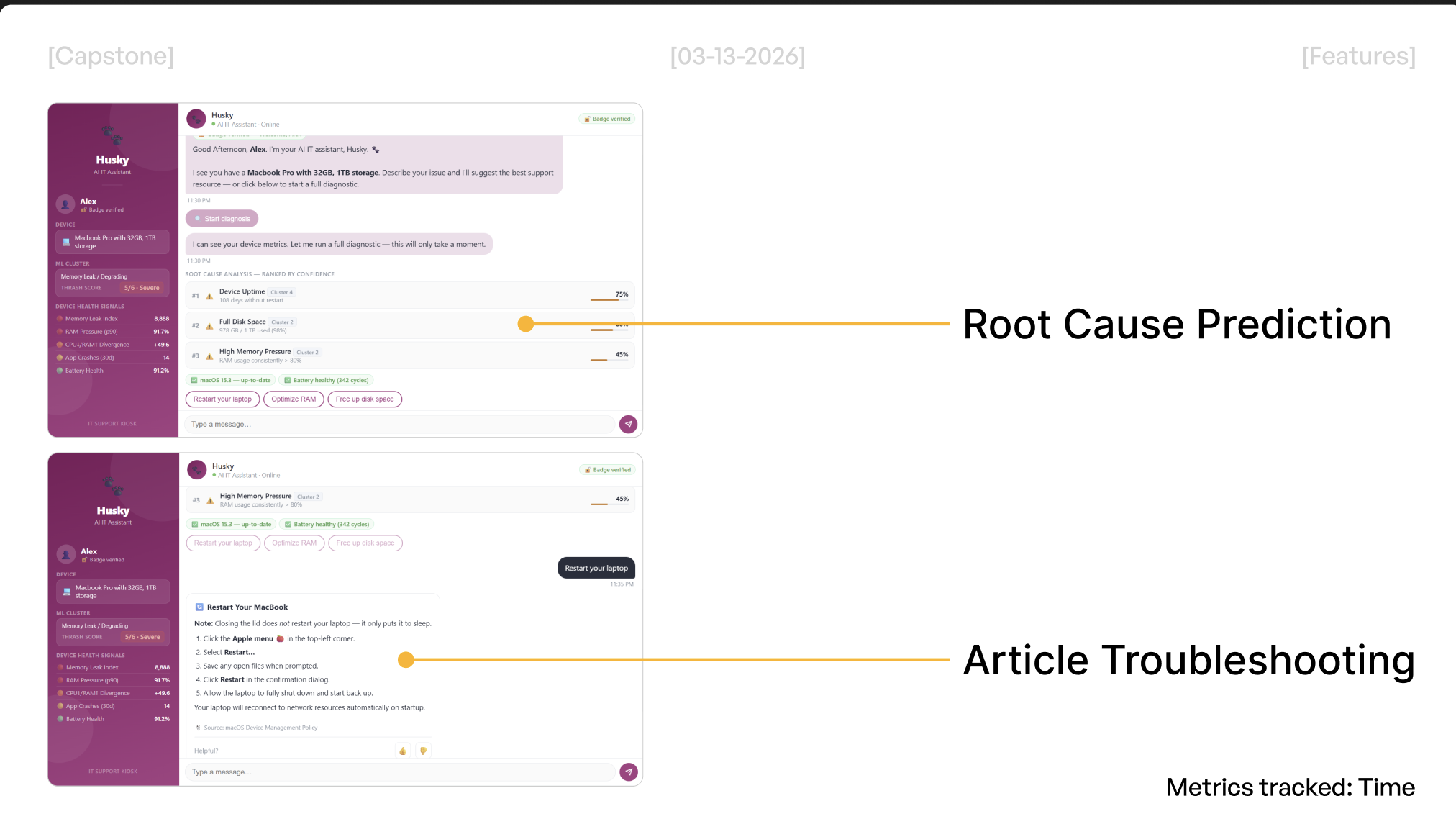
From the research we performed, members of our team put together a frontend interface with Claude. It functions as a Slack chatbot that delivers proactive alerts via DM with ranked root causes and confidence scores.
Our backend team trained a random forest model on 90th-percentile telemetry data across 12 device features (memory utilization, boot time, CPU capacity, battery cycles, etc.) to predict imminent system failures. We are now working on defining thresholds for the most accurate crash detection to implement in our model. This will soon be integrated with the frontend and backend, creating a complete, functioning system.
🌱 My Role and Contributions
I initially started out on the UX Research and Design team, but realized that the data side needed some more support, so I shifted my efforts over to the data team because I have some knowledge of data science.
Here were my responsibilities in total:
On the UX team: Helping perform user research and analysis - supporting user interviews, summarizing findings, helping write research surveys, summarizing research, and finally, helping translate research into designs and concepts.
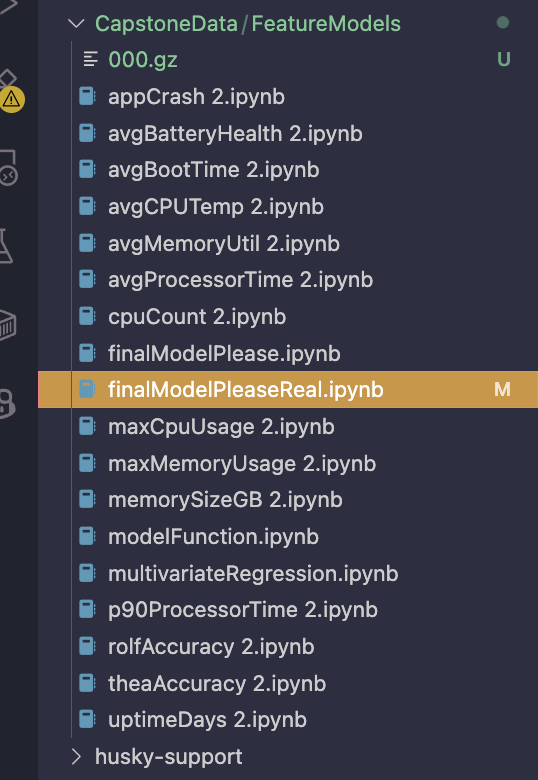
On the data team: Writing algorithms for all variables and testing them. Defining thresholds, performing analyses, and helping write the final random forest algorithm.
I worked much harder on this than the time that was allocated - at one point in the quarter, I was averaging 25 hours on capstone weekly.
👥Team Contributions
Together, the team has accomplished a lot:
We have weekly meetings where we discuss the scope and whether new propositions to scope impact the other parts of the team
We work on pitch presentations to the company and to our capstone class
We discuss user research and data files frequently, comparing notes and redefining our work frequently upon exchanging observations.
Takeaways🛠️
The data that is surfaced from our model will be entirely useless if it is not conveyed in a way that is understandable to all users who navigate our Slack interface. Thoughtful UX design is very important here.
Even if the accuracy is not in the range we want it to be, it is important to justify our development decisions in case this project is picked up by another team.
It is important to avoid changing the scope very late into the project, because it will disrupt the flow of the entire team and create issues with the timeline.
✅ NEXT STEPS
Perform user validation on our product, and determine if there needs to be any tweaks
Complete the model with updated thresholds for issues with computers, and test it on new user data
Tie the model in with the backend and frontend to create a cohesive product
Create a pitch presentation to pitch the product to stakeholders and company